
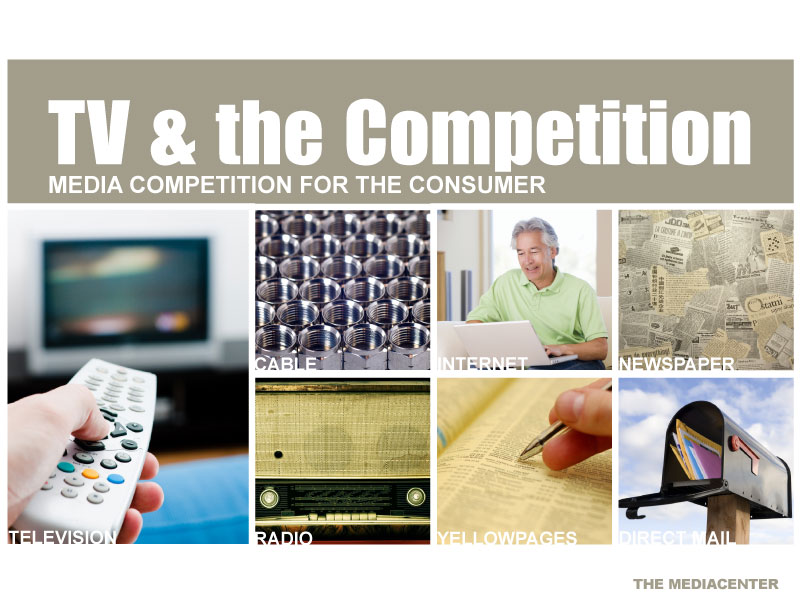
TV & THE COMPETITION: MEDIA COMPETITION FOR THE CONSUMER
Americans lead media-driven lives, and technology is always changing how businesses can communicate with consumers. Not so very long ago, advertisers were limited to static media like billboards, newspapers, direct mail, and the Yellow Pages; radio, television, and cable followed. Social media and the internet are the newest tools in the box. With all these options, it can be hard to choose what to...
TV: WHERE PEOPLE GO FOR THE NEWS
Television remains the most popular choice for national and international news, despite the growth of online news sources. There has been continued expansion of news time on local television, setting a record high in 2010. During that time advertising on local news programs contributed 46.8% of the average station’s revenue, according to a survey of news directors. Although TV viewership has increased overall, both local morning and late night time slots experienced the most growth in 2011.
WHY WEATHER MATTERS: SUNNY OR STORMY FOR LOCAL NEWS?
Weather forecasting has been around since the 1700s, when the nation’s livelihood literally depended on the weather. Benjamin Franklin published his own weather reports, as did Robert B. Thomas, whose Farmer’s Almanac is still published to this day. As technology supported new media like radio, television, and the Internet, weather was always a staple of any news broadcast—though today’s

GRANT WRITING
A number of industries and potential advertisers can benefit from grant money. Nonprofit organizations usually rely heavily on grants to finance operations and special projects, but the media can also benefit from these funds. Partnering with a nonprofit organization to apply for grant money gives your station a chance to help the group reach its goals, while generating revenue for your station.
THE MEDIA MAP
Today’s Media Map is as complex and dynamic as the map of the Earth – the winds of change erode the high points, the fastest-flowing channels can be reduced to a trickle or disappear entirely and unpredictable forces can suddenly and dramatically alter the landscape.
LGBT MARKET: EQUALITY AND DIVERSITY IS GOOD BUSINESS
The Founding Fathers were quite progressive for their time when they declared that all “men (and women) are created equal.” Living in the 18th century, it’s not surprising that they didn’t take the next step and realize that although all are equal, all are also different. Since then, especially during the late 20th century and the first decade and a half of the 21st century, people have come to understand that inclusiveness, or societal diversity, is a strength.

THE 21ST CENTURY DAD
When the history of the last 50 years is studied and analyzed hundreds of year from now, it is likely to be recognized as the first epoch of equality. Seemingly every day, stereotypes and biases about gender, age, race and sexual orientation are being rejected and being replaced by genuine efforts to treat everyone equally. Often, lost among all these seismic changes is the major transformation of the role of men.
THE NEW CITY
The Most Profound Change, Positive, meaningful change can seem to take forever, and then, during a single moment, we collectively take a giant leap across the divide., A spacecraft’s encounter with Pluto. The US Supreme Court rules that same-sex marriage is constitutional

SPORTS MARKETING
Quite likely, the dominance of sports in modern American culture is only exceeded by the biggest non-athletic competition, politics. Kantar Media’s report on total US advertising expenditures for 2014 – a 0.7-percent increase to $141.2 billion – supports this conclusion, as it stated the increase was attributable to the Winter Olympics, World Cup and the mid-term elections. According to Kantar
PRINT MEDIA
The news media, including newspapers and news magazines, are often criticized for printing only the bad news. If they printed editions with coverage of their own industry, then they wouldn’t have much choice but to print the bad news because the good news for print media is difficult to find. There are a few sparks of life, however, and more so in magazines than newspapers, as the conversion from the physical to the digital version of print media continues albeit slowly.
GENERATION Z
The Baby Boomers were much heralded; their children, Generation X, were somewhat ignored by comparison; and Generation Y, the Millennials, have been discussed and dissected for most of the last 10 years and continue to be probed and closely scrutinized under the microscope of marketing research.

TRENDS 2016: ACCELERATING TOWARDS AN ALL-DIGITAL WORLD
The Trends 2015 Special Report from THE MEDIACENTER focused on the “New Consumer.” These are the consumers who want to have significant influence over companies’ current products and services and those they are developing as well as how, when and where those companies communicate and interact with them.
TV & THE COMPETITION
Benign metaphors, such as landscape and universe, have been used to describe today’s media. As we advance further into the 21st century, “media jungle” may be a better metaphor, however. Although there are more media consumers, the competition has become so fierce for them that it is truly the survival of the fittest.

THE EVOLVING CONSUMER
Consuming in a World of Contrasts It appears many (if not most) Americans are living one life with two contrasting mindsets. Understanding these mindsets is the first step in understanding how consumers are evolving and creating challenges and opportunities to retailers.
OUT-OF-HOME MEDIA
As with all other advertising media, out-of-home is just as vulnerable to and enhanced by technology. According to the Outdoor Advertising Association of America (OAAA), 2015 revenues increased 4.6% to a total of $7.3 billion, a significant improvement over 2014’s weak numbers.