
Unlocking Local Media Growth: INMA’s New Roadmap for Navigating the Digital Ad Landscape
The International News Media Association (INMA) has launched a new initiative designed to help media organizations mdash;including local newspapers, magazines, radio, TV, billboards, and digital publishers mdash;navigate the increasingly complex digital advertising world. Spearheaded by industry veteran Gabriel Dorosz, the initiative offers practical guidance on data use, ad innovation, cross-platform strategies, and leveraging AI for better monetization. Through webinars, reports, and live sessions, INMA aims to equip local media sales teams with the knowledge and tools they need to stay competitive and profitable. As digital now commands 75% of global ad spend, this effort is timely and vital for salespeople aiming to evolve their strategies and grow their revenue.
Adapting to the Digital Shift: How Local Media Sales Teams Can Thrive in 2025
In 2025, local media salespeople in newspapers, magazines, billboards, and TV face growing competition from digital platforms like Google and Meta, necessitating innovative sales strategies. By leveraging industry trends, co-op advertising opportunities (available from MarketingInsights.Info) and tailored presentations, sales teams can emphasize their media rsquo;s unique strengths to drive revenue. This article explores actionable strategies to help local media sales professionals adapt and succeed in an evolving advertising landscape.
From Selling Ads to Driving Growth: A Smarter Strategy for Local Media Sales Teams
Too often, local media salespeople mdash;across newspapers, magazines, billboards, TV, and digital mdash;only enter the conversation once an advertiser has already finalized their product, audience, media mix, and message. At that point, there #39;s little room for real influence. To stay relevant and valuable in today rsquo;s complex marketing landscape, local sellers need to shift from selling media products to helping clients achieve business growth. By focusing on client outcomes instead of ad inventory, media sellers can reclaim their seat at the table and build deeper, longer-lasting partnerships.
New Local Businesses Are Fueling a Traditional Media Revival: Are You Ready?
A new report from Borrell Associates reveals that recently established local businesses are breathing new life into traditional media mdash;including radio, TV, print, billboards, and direct mail mdash;with a notable increase in ad spending. Radio leads the way with an average advertiser spend of $48,060, topping even television. The growth in small business formation post-pandemic has created an influx of new advertisers who often favor traditional media channels for their perceived effectiveness and hands-on support. This shift signals a vital opportunity for local media sales reps to reconnect with Main Street and capture growing budgets from newer, often underserved advertisers.
Cracking the Perception Gap: What Local Media Sellers Can Learn from Radio’s Ad Challenges
Despite radio rsquo;s strong audience reach and cost-efficiency, major misperceptions among advertisers are causing significant underinvestment in the medium. These challenges mdash;and how the Radio Advertising Bureau (RAB) is addressing them mdash;offer critical insights for all local media sellers, including newspapers, billboards, TV, magazines, and digital. Like radio, these platforms often face outdated assumptions that affect their share of ad budgets. This article outlines key data, strategies, and messaging that local sellers can adopt to better position their value in today rsquo;s competitive media mix.
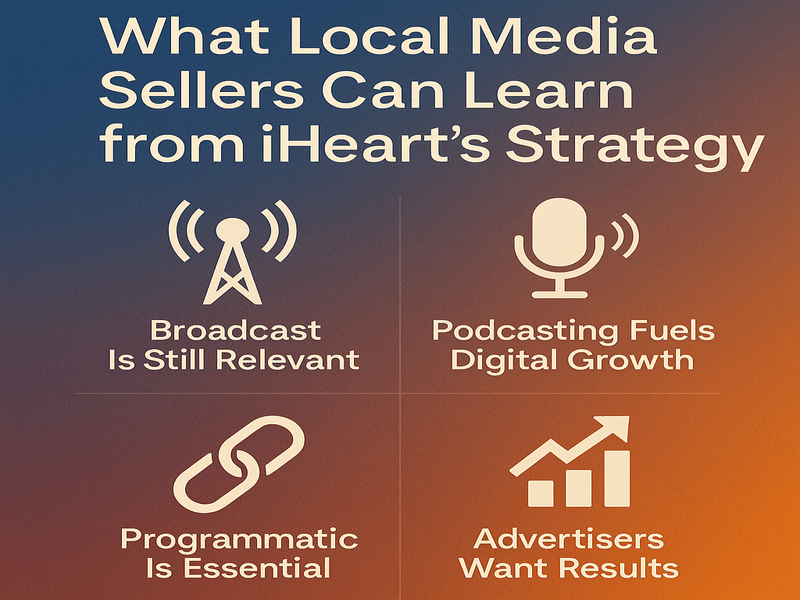
How iHeart’s Growth Strategy Signals Key Trends for All Local Media Sellers
iHeartMedia rsquo;s latest earnings report offers an encouraging look at how legacy media companies can successfully adapt to the evolving advertising landscape. While digital remains the fastest-growing division mdash;led by podcasting mdash;there are signs of stabilization and renewed momentum in broadcast radio, particularly in national network sales. The company rsquo;s focus on ad tech, programmatic inventory, AI-driven efficiencies, and integrated media sales serves as a useful playbook for local sellers across all media. For newspapers, magazines, TV, digital platforms, and billboards, the big takeaway is clear: advertisers want multiplatform solutions, measurable performance, and efficient reach mdash;and media companies who deliver those will win.
Radio Still Reigns: Why Audio Advertising Delivers High-Value Consumers Across All Media Channels
A recent analysis by Katz Radio Group using Nielsen Scarborough data highlights that consumers influenced by radio ads are not only highly engaged but more likely to take action than those influenced by other media like TV, digital, print, or outdoor. From sports betting and luxury car purchases to theme park vacations and fine jewelry, radio-ad-influenced consumers consistently outperform across categories. For local media sellers mdash;including newspapers, magazines, billboards, TV, and digital mdash;this data provides a compelling case for integrating or aligning with radio-style messaging strategies to reach decision-ready audiences. The findings also reaffirm the value of cross-platform promotions and help inform smarter media strategies in a shifting advertising landscape.
Why Local Radio Still Matters in 2025 — And What It Means for All Local Media Sellers
A new report from Crowd React Media, part of the Harker Bos Group, highlights that AM/FM radio remains a vital part of the media mix for U.S. adults, with 76% still tuning in regularly. Local media sellers mdash;from newspapers to TV, out-of-home, and digital mdash;can draw key lessons from radio rsquo;s ongoing relevance: consistent local content, trusted personalities, and convenient access are what keep audiences engaged. Radio rsquo;s dominance during commutes and work hours proves that locally driven, real-time messaging still cuts through. For media reps looking to align with advertisers, the report is a powerful reminder that audience connection often hinges on community relevance and trusted, habitual platforms.
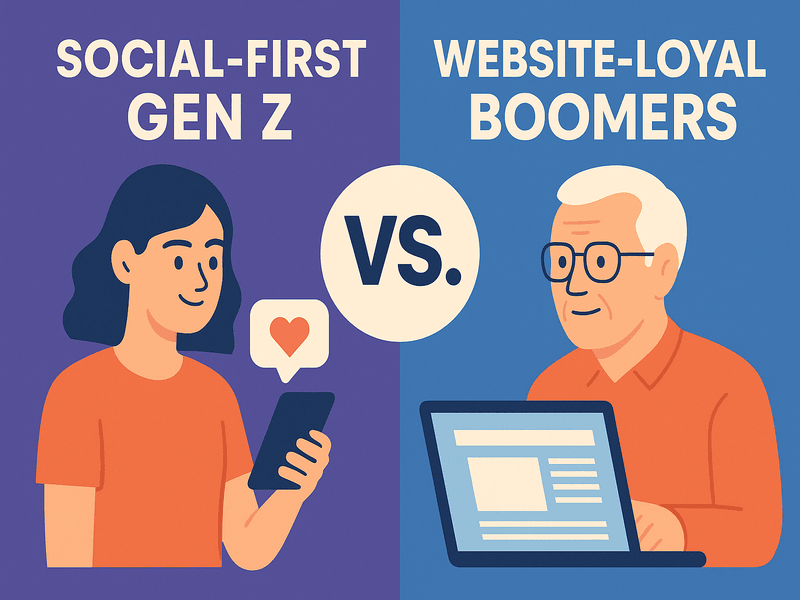
Generational Marketing… What Gen Z and Boomers Want (And How Local Media Can Deliver It)
Understanding how different generations consume media and interact with advertising is critical for local media sales success. A recent pair of studies reveal that Gen Z favors social media and interactive content, while Baby Boomers rely on websites, reviews, and informative messaging. Gen Z still values email—particularly in professional settings—but with different expectations than older cohorts. For local media sellers, tailoring content formats and advertising strategies to each generation's preferences is key to boosting engagement and driving ad revenue.
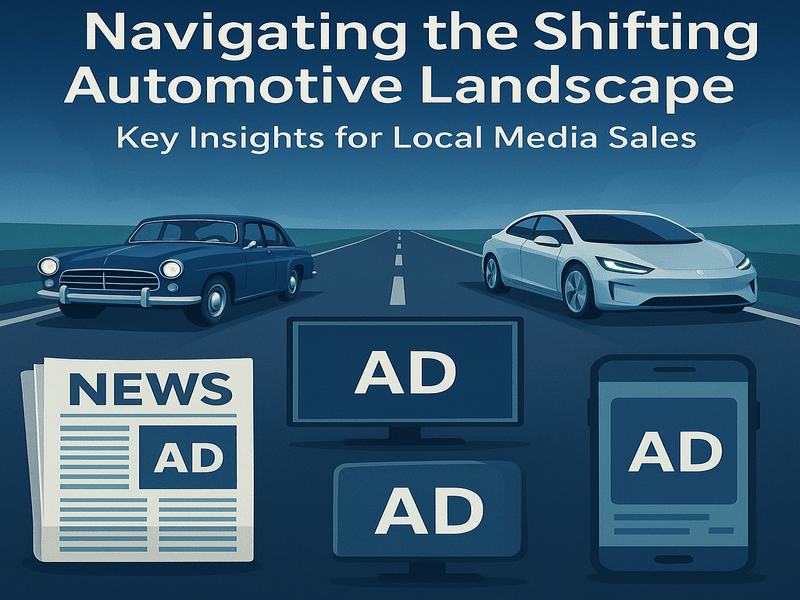
Navigating the Shifting Automotive Landscape: Key Insights for Local Media Sales
This article provides valuable insights for local media salespeople in newspapers, magazines, billboards, TV, and digital platforms. It covers recent developments in the automotive industry, including tariff adjustments, technological advancements, and production shifts. Understanding these changes can help media sales professionals tailor their strategies to better serve automotive clients and capitalize on new advertising opportunities.
Navigating the New Media Landscape: Insights for Local Media Sales from Horizon Media's Study
A study by Horizon Media reveals that Millennial parents and their Gen Alpha children are exhibiting new consumption behaviors, emphasizing multi-platform, interest-driven engagement. Traditional top-down influence models are becoming obsolete, with peer and community-driven influence gaining importance. The study highlights the shift from hyper-personalization to community-driven discovery and the importance of content relevance over creator popularity. These insights are crucial for local media salespeople, helping them adapt their strategies to resonate with today's dynamic audience.
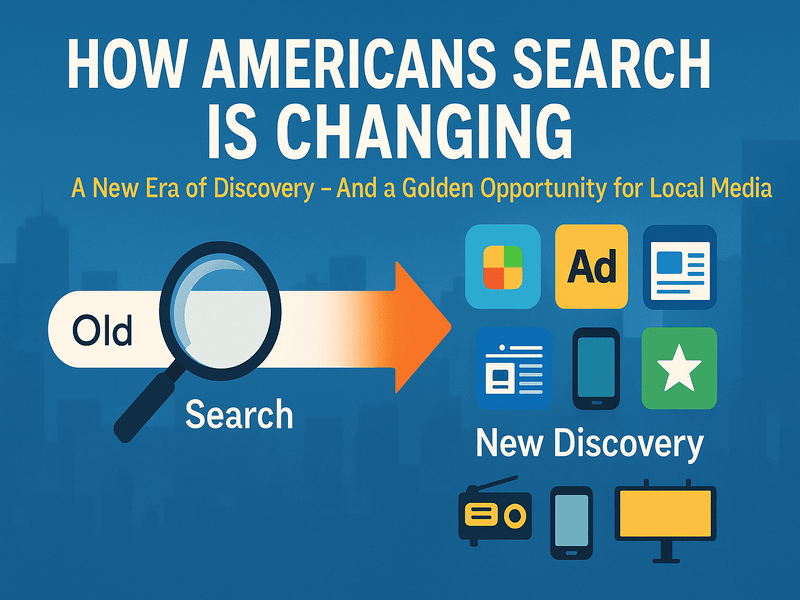
How Americans Search Is Changing And What It Means for Local Media Sales
A new report shows that 55% of Americans say their online search habits have shifted significantly over the past five years—and they're increasingly discovering products through ads, editorial content, and apps rather than traditional search engines. This evolution marks a major opportunity for local media sellers: consumers trust ads across multiple platforms and make quick purchasing decisions when they discover products via native, embedded content. For local sales teams, the key takeaway is clear—you don’t have to be Google to win in the search-driven economy. You just need to help advertisers show up in the right context, across trusted platforms.
The Importance of Legacy Media - Influence on Social Media Engagement
Executive Summary A study by Critical Mass Insights reveals that radio listeners are significantly more likely to engage with social media ads for products they’ve heard advertised on the radio. The survey, conducted among 1,000 U.S. consumers aged 18-64, found that 55% of listeners are more likely to click on social media ads after hearing a radio ad, with this likelihood rising to 64% among adults aged 25-44. Additionally, 72% of consumers are more likely to notice social media ads for products they’ve heard about on the radio, and 7 in 10 are more likely to read and try new products advertised on social media after hearing about them on the radio. This study highlights the powerful synergy between legacy media, specifically radio advertising and social media engagement, making it a valuable strategy for local media outlets.
Media Usage Expected to Dip in 2025 - Why It’s a Wake-Up Call for U.S. and Canadian Media Sellers
For the first time since 2009, total media usage across the U.S. and Canada is expected to decline, with a projected 0.3% dip in 2025 according to PQ Media. The slowdown highlights how digital media growth can no longer offset traditional media declines — but it also reinforces that traditional media still commands strong, high-quality audiences. For local media sellers, it’s a prime opportunity to position broadcast, print, and trusted digital outlets as powerful, stable options for advertisers aiming to maximize reach in a fragmented landscape.
Radio’s Office Comeback: AM/FM Surges as Americans Return to Office
New research from Edison shows that AM/FM radio listening at work has jumped 10 share points year-over-year, signaling a major shift as more Americans return to office routines. AM/FM continues to dominate ad-supported audio in the car and is now the leading choice on smart speakers. With 66% of U.S. adults tuning in daily, radio offers consistent, high-impact reach across devices and demographics. Combined with podcasting’s rapid growth, audio is once again proving to be a cornerstone of effective advertising.