The Programmatic Wake-Up Call: Why Local Media Is More Valuable Than Ever
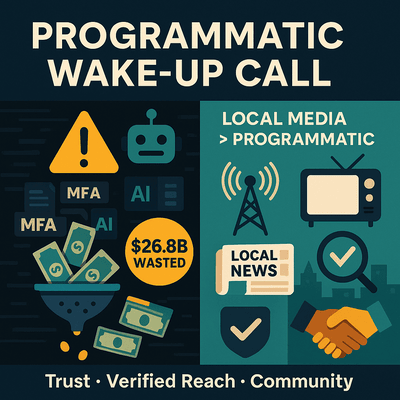
In the world of advertising, few numbers hit harder than this: $26.8 billion. That’s how much global advertisers wasted on programmatic ad spend in just one quarter, according to the Association of National Advertisers (ANA).
Let that sink in. That’s not the total spend—it’s the waste. Dollars that didn’t reach real people. Ads that landed on junk websites. Impressions that looked good on paper but didn’t drive results. And it’s happening while marketers are chasing efficiency, automation, and scale.
For local media professionals, this is more than a headline—it’s an opportunity. Because while programmatic advertising is struggling with transparency and performance, local media is quietly doing what it’s always done best: reaching real people, in real communities, with real impact.
The Programmatic Problem
Programmatic makes up 85–90% of digital ad spend, and digital makes up about 62.7% of total ad spend.
The ANA’s Q2 2025 Programmatic Transparency Benchmark Report is a sobering read. It found that 36.5% of programmatic spending went toward impressions that failed to meet basic quality standards. That’s down slightly from 37.8% in Q1, but still a massive chunk of wasted budget.
Even worse, many advertisers are still overexposed to Made-for-Advertising (MFA) sites—low-quality websites designed solely to host ads. These sites often score well on surface-level metrics like viewability, but they’re riddled with invalid traffic, fake content, and inflated CPMs. In fact, 45% of advertisers paid more for MFA impressions than for legitimate ones.
And now, thanks to AI, we’re seeing a rise in “slop sites”—AI-generated junk pages that look real but are filled with plagiarized content and fake authors. As one analyst put it, “Your grandma could set up a slop site and monetize it within a month.”
The Efficiency Myth
Programmatic advertising promises efficiency. But the ANA’s data tells a different story:
- True CPM Delta—the gap between what advertisers pay and what they actually get—is still high.
- Invalid traffic rates are nearly six times greater on MFA sites than on legitimate ones.
- Transaction costs eat up more than 25% of total spend, before the ad even runs.
Why Local Media Still Works
While programmatic struggles with bots, slop sites, and inflated metrics, local media continues to deliver:
- Trusted environments: Local newspapers, radio stations, and TV channels have built relationships with their audiences over decades.
- Verified reach: Local media uses audited data and real-world metrics—not proxies or clickbait.
- Community relevance: Local ads speak directly to the people who live, work, and shop in the market.
Email: The Comeback Channel
While social media referral traffic is collapsing, email is thriving. It’s direct, measurable, and increasingly monetizable.
In 2025, email marketing is being transformed by:
- AI-powered personalization
- Interactive content (polls, quizzes, countdowns)
- Privacy-first design
- Sustainability-focused campaigns
For local advertisers, email offers a way to build relationships, drive engagement, and generate revenue—without relying on third-party platforms or algorithms.
SEO Is Evolving—Meet GEO
Search Engine Optimization (SEO) has long been the backbone of digital visibility. But now, it’s being disrupted by Generative Engine Optimization (GEO).
GEO is about optimizing content for AI-powered search engines like ChatGPT, Perplexity, and Google’s AI Overviews. These platforms summarize content directly in search results, reducing the need to click through to websites.
Publishers report a 30–50% decline in organic traffic from Google, as users get answers without visiting the source.
For local media, this means two things:
- Traditional SEO isn’t enough—you need to optimize for AI visibility.
- Local relevance matters more than ever—because AI engines prioritize context, trust, and clarity.
Here’s how local media can leverage these trends:
1. Emphasize Trust
Local media outlets are trusted sources. Use that credibility to differentiate from programmatic platforms riddled with fraud and MFA exposure.
2. Offer Audited Data
The Media Audit and similar tools provide verified audience insights. Show advertisers how your reach compares to inflated digital metrics.
3. Integrate Email and Social
Help clients build email lists, run newsletter sponsorships, and use social media to amplify local content.
4. Educate on GEO
Teach advertisers how to optimize for AI search engines—and how local media content can support discoverability.
5. Run Incrementality Tests
Use geo-based holdouts to measure real lift from local campaigns. Show clients what’s working—and what’s not.
What Advertisers Should Ask
If you’re a local advertiser, here are five questions to ask your media partners:
- How do you verify your audience?
- Can you show me real engagement—not just impressions?
- What percentage of my spend reaches actual people?
- How do you measure campaign lift?
- Can you help me build long-term customer relationships?
The Bottom Line
Programmatic advertising isn’t going away. But it’s facing serious challenges—fraud, inefficiency, and declining trust. Meanwhile, local media is gaining ground by doing what it’s always done: delivering real results in real communities.
As Bob Liodice, CEO of the ANA, said: “The billions in unrealized value and dip in efficiency make it clear that optimization and transparency must remain top priorities.”
For local media professionals, that’s not a warning—it’s a rallying cry.
Sources:
ANA Finds $26.8B in Programmatic Waste: What Marketers Can Do Now | Measured®
TOP PROGRAMMATIC ADVERTISING STATISTICS 2025
.png)