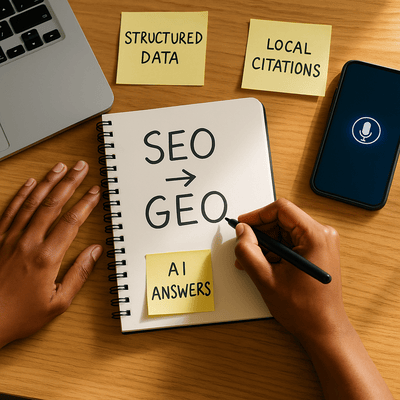
SEO isn’t dying — but this year it’s being rewritten from the ground up.
Read Time: 10 minutes
The oft-quoted line by Mark Twain – “Reports of my death are greatly exaggerated” – may just as well apply to Search Engine Optimization (SEO). While some voices in marketing proclaim SEO’s imminent demise, the truth is more subtle: SEO remains critical, but its central role in brand-discovery is shifting beneath our feet.
According to WPP’s Chief AI Officer Dr Daniel Hulme, marketers must stop optimising only for what people type and instead optimise for what artificial-intelligence “knows”. With personal AIs and chatbots increasingly mediating discovery and purchase decisions, brands — especially in local markets — must rethink how they show up.
Why this matters to local media and ad agencies
For regional and community-focused media outlets, independent local ad agencies, and local advertisers, the implications are immediate:
- The pathways to discovery are changing
Consumer behaviour is evolving. More shoppers are asking AI assistants such as ChatGPT, Claude, Gemini, or Perplexity for purchase advice rather than simply typing keywords into Google. Hulme points out the shift: “AI excels at finding insights in data and making predictions with unprecedented accuracy.” WPP+1
In fact, one analysis estimates that as many as 13 million Americans already prefer generative AI for search, with projections to exceed 90 million by 2027. Ignorance
Meanwhile, with reports that roughly 25 % of searches will bypass traditional engines by next year, brands that ignore AI-mediated discovery risk being unseen. (See citation below.) Foundation Marketing+1 - Traditional ranking may matter less—being cited matters more
The battle is no longer simply for page one of Google; it may soon be for the featured answer inside an AI-agent’s response. The discipline of Generative Engine Optimization (GEO) is emerging as the new frontier. Seer Interactive+1
For a local business, showing in an AI-driven answer (“What is the best pizza in Rockland County?”) may carry more impact than traditional link-ranking. - Local brands and media reps have a unique opportunity
Local advertisers can gain visibility by leveraging specificity: niche geographies, hyper-local relevance, and trusted community voices. Regional media and ad agencies that help brands navigate this shift early will capture a competitive lead.
What “GEO” really means: beyond keywords to knowledge graphs
Let’s dig deeper into what’s changing.
What is GEO?
Generative Engine Optimization (GEO) is the practice of optimising your brand, content and presence so you show up in AI-generated responses, rather than just in search result listings. Foundation Marketing+1
Where SEO asked: “How do I get my link to show up when someone types keywords?” — GEO asks: “How likely is it that an AI-assistant will cite you as the answer, without sending the user through multiple links?”
As one academic summary explains: “The advent of large language models (LLMs) … ushers in a new paradigm of search engines that use generative models to gather and summarise information.” arXiv
How GEO differs from SEO—and what remains the same
- Keywords and links are still part of the equation, but the emphasis shifts to entities, associations, citations and machine-legible knowledge. SEO.com+1
- GEO doesn’t replace SEO—it builds on it. Brands that already rank well tend to get cited more often in AI answers. mangools+1
- For content strategy, the shift is: from “How do I target the search term?” to “How do I become the associate that AI links to the concept?” As one article puts it: “When asked ‘best skincare brand’, AI draws from statistical patterns across millions of training materials. If your brand wasn’t in those sources, you effectively don’t exist.” (Paraphrased from our original brief.)
Why the urgency
For local advertisers, delaying a GEO strategy is risky. As Hulme cautions: the window to shape how AI “knows” you is now. Because training datasets and model updates influence visibility tomorrow, what you do today affects discovery later. WPP+1
In other words: you may not lose page rank—you might simply not get asked.
A GEO game-plan for local market media and agencies
Here are four actionable steps that local advertisers, media reps and agencies should adopt now.
1. Audit how the AI “knows” your brand
Start by assessing your brand’s presence in multiple AI tools. Ask both branded and un-branded queries:
- Branded: “Tell me about [your business name]”
- Un-branded: “What is the best [category] in [city/ZIP]?”
Notice what AI models say, what other brands appear, what associations are missing or outdated.
Why this matters: GEO visibility depends on how models retrieve and synthesise knowledge from training sets or live sources. If your brand is absent or mis-represented, you can’t show up. Foundation Marketing
Document responses over time—especially after major model updates—and track gaps.
2. Distinguish content for training vs retrieval
Not all content needs to be behind a paywall or gated. Some must be publicly crawlable so that AI systems (especially retrieval-augmented models) can access it. According to GEO strategy frameworks, you must ask: “Which content should be open to ensure discoverability, and which can remain gated for lead-gen value?” Seer Interactive
For local media reps: advise clients to publish region-specific, high-quality content (e.g., case studies, community stories, FAQs) on open platforms so the AI can index and cite them.
3. Optimize conceptually, not just lexically
Since LLMs cluster by meaning rather than exact keywords, you should craft content in natural language that mirrors how your audience thinks. For example: instead of “enterprise SaaS solutions”, use “what’s the best software to manage my team’s projects in 2025?”
This helps the AI understand who you are, what you solve, and why you exist. Local advertisers should integrate geographic, scenario-driven language: “In Tappan, NY, when winter hits, how do you treat a dripping basement?”
Analysts emphasise that “conceptual relevance” matters more than single keywords. Terakeet
4. Build content that is easily extracted, cited and trusted
AI models increasingly rely on entity relationships, structured data, and authoritative mentions when pulling in content. To become that “trusted cite”:
- Use schema markup, entity tags, clear headers.
- Secure third-party mentions (local news sites, directories, community websites) to build credibility.
- Ensure your public content explains not only “what you do” but “how you relate to problems, solutions, competitors, location”.
- Monitor metrics beyond clicks: track “AI visibility score”, “share of citations”, brand mention growth in AI-responses. Guides suggest GEO KPI frameworks rather than classic click-rank metrics. SEO.com
Local-market nuance: what to watch, what to exploit
Here are the practical realities specific to regional markets and local-advertising dynamics.
- Hyper-local queries will dominate – For a business in Rockland County or Westchester, AI queries might be: “best HVAC company near Nyack” or “affordable child-care Rockland County NY”. Using this hyper-local framing gives you a shot to appear in AI responses that emphasise locality.
- Seasonal and topical content can win – For local media reps or regional advertisers, recommending campaigns around time-bound issues (e.g., “prepare your gutters for Hudson Valley winters” or “Tappan-Zee Bridge construction impact for advertisers”) can generate highly relevant, site-open content that AI indexes.
- Cross-channel still matters – GEO doesn’t mean abandoning SEO. Traditional metrics like brand recall, local citation, earned media, and offline campaigns still feed the machine-learning training loop. One expert notes: “The crossover is a good thing because brands can leverage the combined power of GEO and SEO strategy together.” Terakeet
- Measurement remains hazy, but early adopters will benefit – Because AI visibility is newer than organic ranking, tracking is evolving. Some specialists suggest “AI visibility” metrics or “percentage of citations” rather than just “traffic”. Search Engine Land
Why delay is the riskiest strategy
Local advertisers might feel: “Let’s wait until the industry sorts out best practices.” That approach is risky. Because training datasets and model behaviours are evolving constantly, the content you publish today influences your standing in the next wave of AI updates.
Hulme frames it this way: “We’re beginning to see real-world AI mapping at the population level, which has immense predictive power for our clients’ businesses.” WPP
If your brand isn’t part of that mapping, you may simply not be asked when the consumer’s personal AI assistant seeks a recommendation.
The metaphor for local media: you’re no longer just chasing first-page positioning on Google. You’re running to get asked. The brand that appears inside an AI answer is the brand in the consideration set. And for local markets, being in that answer may count more than a click.
Final word for local media agency professionals
For regional ad-agencies, local media sales reps, and community-focused advertisers, the message is simple: start adding GEO to your strategic toolkit today.
- Audit how your brands appear inside AI answers today.
- Work with advertisers to publish open, well-structured content that addresses local, scenario-driven queries.
- Integrate GEO efforts into broader campaign work with local media outlets: press-releases, region-specific blog posts, local features that AI can cite.
- Track not only SEO-rank and clicks, but new metrics like “AI citations”, “visibility in generative responses”, “brand-entity appear-rates”.
By doing so, you’ll help your advertisers not just show up—but be recommended. In a world where AI agents increasingly make purchase decisions or recommendations on behalf of consumers, being visible inside that moment is becoming everything.
The question isn’t whether GEO will reshape how brands are discovered. It’s whether your brand will be part of the conversation.
Source: https://www.thedrum.com/opinion/2025/10/17/seo-dead-long-live-geo