Meta Turns AI Chats into Ad Targeting Fuel
Read Time: 8 minutes
What Local Media Sellers and Agencies Should Know Ahead of December 16
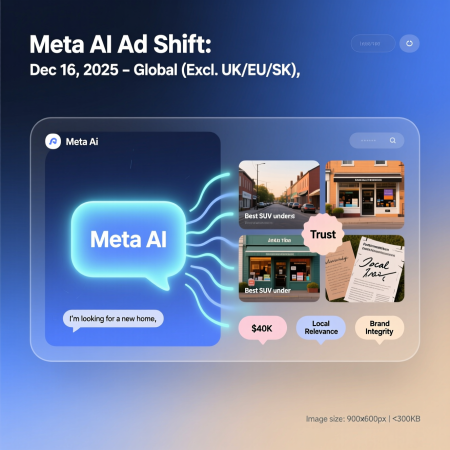
Meta Platforms is about to rewrite one of the central rules of digital advertising: come mid-December, the company will begin using data from user interactions with its AI assistant to power targeted ads across its social platforms. While the change does not apply in the U.K., European Union, or South Korea (due to local privacy laws), it will come into effect in most other markets starting December 16, 2025.
This move effectively opens a new “data tap” for Meta: the content of user-AI conversations—once perceived as a private channel—becomes input into the company’s ad engine. For local media sales teams and marketing agencies, the implications are far from academic. The shift forces a reworking of competitive positioning, client education, and the definition of premium local media value.
The Mechanics: From Likes to Language
What’s Changing
Historically, Meta (through Facebook, Instagram, WhatsApp, etc.) has constructed ad profiles using behavioral signals: clicks, likes, shares, browsing patterns, device metadata, and social graph connections. Now, user-AI interactions will join that mix. In conversations with Meta’s chatbot (Meta AI), users often reveal direct intent: “I’m planning a hiking trip,” “I’m shopping for a new coffee maker,” or “I need recommendations for local contractors.” Meta will soon use those signals to shape both ad selection and content recommendations.
Meta states it will exclude “sensitive” categories such as religion, health, sexual orientation, race, political views, philosophical beliefs, and union membership from targeting models.
Starting December, opting out will not be an option—users who use Meta AI will be included by default in this new targeting paradigm.
The policy will also extend beyond text chat: Meta’s wearables and smart glasses (which may capture audio, images, and video) are part of the expanded data perimeter.
Why Meta Is Doing This
- Deeper intent signals. Unlike a “like” on a post, an AI conversation often contains natural language clues about consumer interests, aspirations, needs, and timing.
- Competitive pressure. Other platforms are pushing AI integration into ad targeting; Meta needs to stay ahead in the arms race of data signals.
- Monetizing AI. The change helps Meta convert its AI investment into incremental revenue streams as its AI user base grows.
Meta says AI conversations will be “one of many signals” in its targeting toolbox—not the sole determinant of ad delivery.
The Local Media and Agency Stakes
The Competitive Benchmark Just Got Sharper
Imagine you’re pitching local HVAC, plumbing, or roofing clients. Previously, your competitive counterpoint might be: “Yes, Facebook can microtarget, but local media has reach, brand context, and trust.” But now Meta can surface as many as thousands of “in-market” local homeowners who asked AI: “Which furnace should I buy this winter?” or “Need a plumber this weekend.” That precision challenges the breadth-based pitch of local media.
Your sales team will need to reframe how they talk about local advantage:
- Emphasize trusted contextual placement over algorithmic targeting—people remember ads next to relevant, local news or in a community context.
- Sell message repetition across formats (print + radio + outdoor + web) as the guardrail against overreliance on one data engine.
- Underscore local brand equity—AI-powered ads might convert, but they rarely build trust or memory the way local media campaigns can.
Client Education Becomes Essential
Many local advertisers—even savvy ones—won’t understand the shift from click-based signals to language-based signals. Local sales and ad agencies should proactively educate clients:
- Explain the trade-offs. AI-targeted ads may seem efficient, but they risk creeping into perceptions of surveillance and “creepiness” if not presented tactfully.
- Surface the limitations. Meta is excluding “sensitive” categories, but ambiguity remains about borderline topics. Also, users can’t opt out—a fact many will find controversial.
- Promote transparency. Encourage clients to monitor performance metrics and build guardrails around conversions versus brand outcomes.
An informed client is less likely to write off local media as irrelevant—and more likely to allocate budgets across channels.
Position Local Media as a Risk Diversifier
Given the increased concentration of ad power in platforms like Meta, local media can position itself as a diversification play: a hedge against algorithm changes, black-box decisions, or bias in ad platforms.
- In pitches, include scenario planning: if that new AI-targeting algorithm shifts tomorrow, how much of your client’s budget is at risk? Local media often carries less risk because its value is less attached to algorithmic opaqueness.
- Use case studies of past “platform blunders” (e.g., news feed algorithm rollouts that disrupted reach) to show how local media consistently outperforms volatility.
Updated Workflow in Agency Planning
Agencies, in particular, will need to embed this shift into media planning and measurement. Some suggested changes:
- Audience overlap audit. As Meta’s ability to microtarget increases, the overlap between Meta audiences and local audiences might grow. Audit how much of a client’s audience could be targeted by both, and optimize accordingly.
- Attribution architecture rethink. With more precision in “bottom-of-funnel” conversion signals, agencies must guard against cannibalizing brand-building budgets in favor of short-term clicks.
- Creative governance. When AI-targeted ads appear, local media creative needs to compete in punch, relevance, and emotional resonance—not just reach. Invest in sharp messaging and local credibility.
Challenges, Risks Open Questions
Privacy Blowback
Despite Meta’s assurances about excluding “sensitive” signals, many users and advocacy groups will see this as a privacy intrusion. There will likely be consumer backlash, class-action lawsuits, and regulatory scrutiny. Already, in Europe, Meta’s “consent-or-pay” models face intense regulatory headwinds.
Explainability and Control Gaps
Research suggests that AI-mediated ad targeting tools struggle to offer meaningful explanations for ad delivery. Users trying to “see less” of a topic may not succeed, and targeting rationales often fail to account for local targeting criteria.
Local media sellers should anticipate client questions: “Why did my ad run to that person?” or “Why is my competitor reaching the same audience even though I’m paying more?” And be ready to explain the limits of algorithmic transparency.
Bias and Ethical Risk
Advanced models may inadvertently infer sensitive attributes (e.g., socioeconomic status, race, religion) from non-sensitive language. Recent auditing work warns that ad streams themselves can form a profile from which sensitive attributes are reverse-engineered. (arxiv.org)
Agencies and media sellers should demand clarity from platforms about bias mitigation, especially when targeting local populations where demographics may shift sharply block to block.
Uneven Global Application
Because of stricter privacy regimes, the change won’t apply in the EU, U.K., or South Korea—at least initially. (techcrunch.com) Agencies that handle multinational clients must segment strategies by geography.
Integration Complexity
Implementing and measuring this new targeting layer will require updated dashboards, stronger data integration, and perhaps new vendor tools to reconcile AI-driven signals with legacy audience platforms. Local media vendors and agencies should assess their tech stack readiness now.
Action Plan: 5 Steps for Local Media Sellers Agencies
- Educate Your Team (Now). Host internal briefings so your salesforce understands exactly how Meta’s update changes the argument. Compare “old targeting” vs. “AI-chat targeting” and role-play client objections.
- Update Pitch Decks. Insert a “Meta AI targeting” slide in your standard local media pitch. Show clients that the benchmark is now localization + targeting intelligence. Highlight hybrid models: local media plus AI-powered ads working together.
- Build Transparency into Deals. Encourage clients to tag Meta ad spend separately from local media in dashboards. This clarity helps compare marginal cost-per-acquisition across platforms transparently.
- Invest in Strong Creative. Because Meta’s AI targeting gets “smarter,” your creative must be sharper. Local media campaigns must compete not just on reach but on brand impact, emotional resonance, and distinctiveness.
- Monitor Early Signals. As the policy rolls out in December, track CPM and CTR shifts on Meta across local campaigns, changes in audience overlap between Meta and your local inventory, client sentiment, and any regulation that could alter implementation.
Sample Client Scenarios
- Home Services (HVAC, plumbing). A homeowner who asked Meta AI for “best furnaces this winter” could immediately be flagged as an intent-rich lead. But your pitch: Meta gets the conversion. Local media sells the trust needed for that conversion plus future loyalty.
- Auto Dealer. Someone asking AI: “Should I lease or buy a car this year?” becomes a high-value audience. But pairing with local radio test drives or dealer events amplifies recall and foot traffic.
- Retail E-commerce. AI-targeted ads might close sales for commodity goods. But local outlets can support that with “in-store only” offers, driving omni-channel traffic beyond Meta’s click domain.
Final Thought: Reinvent Your Local Edge
Meta’s pivot is less about killing local media and more about ratcheting up the value of what local media can’t easily replicate: place-based trust, community context, brand equity, and defense against algorithmic whiplash.
Local media sellers and agencies who treat this shift as a call to evolve—not a threat to retreat—stand to reclaim relevance in a world reshaping around AI.
.png)