
Keep Your Eye on the Ball: Why Media Must Refocus on the Advertiser
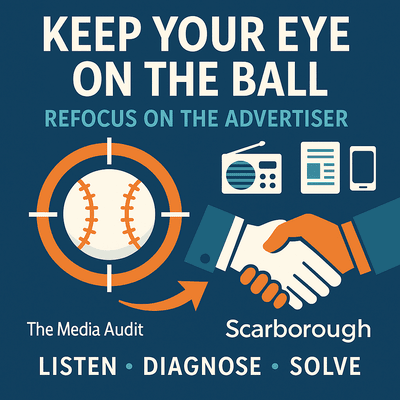
Let’s start with a confession: media salespeople are a bit like golden retrievers at a fireworks show. There’s a lot of excitement, a lot of shiny things flying around, and a lot of barking about the newest digital toy. Programmatic! OTT! AI-powered targeting! TikTok takeovers! It’s all very dazzling. But in the midst of this digital dazzle, something quietly tragic is happening.
We’re losing sight of the ball.
And in this game, the ball is the advertiser.
In the old days—say, 2005—media reps would walk into a local business, shake hands, ask about the owner's kids, and then talk about how their radio station could drive foot traffic. It was simple, human, and effective. Today, that same rep might burst through the door like a caffeinated tech evangelist, armed with a PowerPoint deck and a vocabulary that sounds like it was generated by ChatGPT after binge-watching Silicon Valley.
But here’s the thing: the advertiser doesn’t care as much about your shiny new toy, a digital offering. They care more about their business.
They care about their customers, their competition, their margins, and whether their new location is going to survive the winter. They care about whether their ad dollars are actually working. And they care about whether you, the media rep, understand any of this.
The Rise of Digital and the Fog of War
Digital media has become so embedded in our daily lives that it’s easy to forget how recent this transformation is. We wake up and check our phones before we check on our children. We scroll through Instagram while brushing our teeth. We consume content like it’s oxygen. And for advertisers, this means a dizzying array of options: banner ads, pre-rolls, influencer campaigns, geofencing, retargeting, and more.
It’s a buffet of possibilities. But like any buffet, it can lead to indigestion.
Media reps, understandably, want to be part of the digital revolution. They want to show they’re modern, relevant, and plugged in. But in doing so, they often forget the cardinal rule of sales: it’s not about you. It’s about them.
As one wise media veteran once said, “Don’t sell. Consult.”
The Role of the Salesperson: More Therapist Than Techie
Let’s pause here and consider the role of the media salesperson. It’s not unlike that of a doctor, a lawyer, or a therapist. You’re there to diagnose, to understand, to empathize. You’re not there to prescribe the latest pill just because it’s new. You’re there to ask questions like:
- What are your goals?
- What’s keeping you up at night?
- Who are your competitors?
- What’s your customer profile?
- What’s worked for you in the past?
This is where local market qualitative research services like The Media Audit and Scarborough come in. These aren’t just data dumps. They’re treasure maps.
They provide deep insights into consumer behavior, media consumption, and—most importantly—advertiser categories. They tell you what the advertiser wants to know: Who is my customer? Where do they live? What do they read, watch, and listen to? What motivates them to buy?
As one local advertiser put it, “I don’t care if it’s digital or a billboard. I care if it works.”
No doubt digital works but so does traditional media. They complement each other.
Traditional media delivers reach, trust, and familiarity. It’s the comforting voice on the radio during the morning commute, the billboard that greets you on Main Street, the local newspaper ad a friend clips and mails to you with a note that says, “You should try this place.” It’s not flashy, but it’s effective. And when paired with digital, it becomes a powerful one-two punch: traditional builds awareness and credibility, digital drives engagement and conversion.
This isn’t a turf war—it’s a tag team. The smart advertiser doesn’t choose sides; they build bridges. And the smart media rep doesn’t push one over the other—they use tools like The Media Audit and Scarborough to show how both can work together to serve the advertiser’s goals. These research services don’t just talk about media—they talk about people, habits, and business realities. They help media reps say, “Here’s what your customer looks like, here’s where they spend their time, and here’s how we can reach them—together.”
Bridging the Gap: From Consumer Insight to Media Strategy
The beauty of qualitative research is that it bridges the gap between consumer behavior and media strategy. It doesn’t just say, “Your target audience is women 25–54.” It says, “These women shop at Target, listen to country music, drive SUVs, and are financially optimistic.”
That’s gold.
And when you overlay that with media consumption data—traditional and digital—you get a roadmap. You can say, “Here’s how we reach them. Here’s how we speak to them. Here’s how we help you grow your business.”
This is the kind of consulting that earns trust. It’s the kind that builds relationships. And it’s the kind that leads to long-term ad dollars—not just one-off campaigns.
The Danger of the Shiny Object Syndrome
Let’s return to our golden retriever metaphor. Imagine a media rep walking into a bakery and saying, “We’ve got this amazing new AI-powered, geofenced, retargeted, programmatic video solution that’s going to revolutionize your customer acquisition strategy.”
The baker blinks. “Can it help me sell more cupcakes?”
The rep pauses. “Well… maybe?”
This is the danger of the shiny object syndrome. It’s easy to get so excited about the technology that you forget the goal. And the goal is always the same: help the advertiser succeed.
As the old saying goes, “Keep your eye on the ball.” In media sales, the ball is the advertiser’s business. Not your platform. Not your product. Not your quarterly quota.
Humor, Humanity, and the Art of Listening
There’s a story about a media rep who walked into a car dealership and spent 45 minutes talking about his company’s new digital dashboard. The dealer listened politely, then said, “You know, I just want to sell more trucks.”
The rep blinked. “Right. Trucks. Of course.”
The dealer smiled. “You ever driven a Silverado?”
The rep hadn’t. So the dealer took him for a ride. They talked about torque, towing capacity, and tailgate design. And somewhere along the way, the rep realized that understanding the product was the key to understanding the advertiser.
This is the art of listening. It’s the art of being human. And it’s the art of media sales.
The Path Forward: Consult, Don’t Sell
So what’s the takeaway here?
It’s simple: media companies must refocus on the advertiser.
They must use tools like The Media Audit and Scarborough not just to impress, but to understand. They must train their reps to ask better questions, to listen more deeply, and to resist the urge to lead with the latest digital gimmick.
They must remember that the advertiser is not a target. They’re a partner.
And they must embrace the idea that media sales is not about selling. It’s about solving.
As one wise advertiser once said, “Don’t tell me what you’ve got. Tell me what I need.”
Final Thoughts: The Ball, the Bridge, and the Business
In the end, media sales is a noble profession. It’s about helping local businesses thrive. It’s about connecting communities. And it’s about using the right tools—traditional and digital—to build meaningful campaigns.
But to do that, we must keep our eye on the ball.
We must use qualitative research to build bridges between consumer insight and media strategy. We must use qualitative research to understand our medium’s consumer beyond ratings. We must resist the temptation to chase shiny objects. And we must remember that the advertiser is the most important person in the advertising world.
Not the platform. Not the product. Not the pitch.
The advertiser.
So the next time you walk into a local business, leave the PowerPoint at home. Bring your curiosity. Bring your empathy. And bring your copy of The Media Audit.
Because in this game, the winners are the ones who listen, understand, and serve.
And maybe, just maybe, sell a few more cupcakes.