
The Steadily Rising Power of U.S. Latinos: What Local Media and Ad Agencies Need to Know
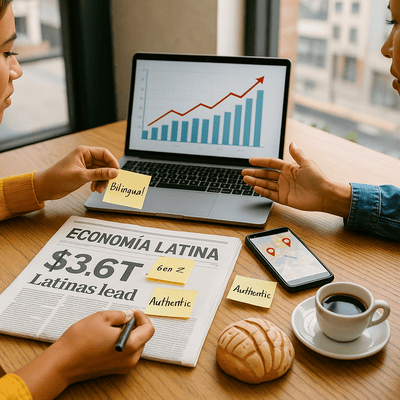
In recent years, the U.S. Hispanic market has moved decisively from “emerging” to “essential.” With a Latino economy now worth trillions of dollars, rising affluence among U.S. Latinas, and younger generations—Gen Z and Gen Alpha—reshaping values and purchase behavior, local media sales representatives and advertisers must adjust not just their messaging but their foundational strategies. The Hispanic Marketing Council’s (HMC) 2025 Hispanic Market Guide and reports from the Latino Donor Collaborative underscore trends that not only forecast where the market is headed, but how local media outlets and agencies can benefit now.
A $3.6 Trillion Economy—and Growing
The economic scale of the Latino market in the United States is now staggering. According to the 2024 LDC U.S. Latino GDP report, U.S. Latino GDP rose to $3.6 trillion in 2022, representing a real‐growth rate of roughly 4.6% annually from 2017 to 2022—outpacing most established first‐world economies.
A particularly striking component of this growth is the economic output of U.S. Latinas. As of the latest figures, Latinas contribute about $1.3 trillion to that U.S. Latino GDP, up from $661 billion in 2010. This share of the Latino GDP is calculated base on female Hispanics wages, business ownership, and consumer spending. If they were counted as a standalone state, their economy would rank among the top four in the U.S., behind only California, Texas, and New York.
These numbers are not just statistics. They are signals to media sellers and agency strategists: the Hispanic market is not niche—it is a major part of mainstream U.S. economic life. Local media outlets that ignore or under‐serve this market are leaving substantial revenue on the table.
Generational Diversity: Gen Z Gen Alpha Are Game‐Changers
Latinos are also younger, and younger populations bring different expectations and affinities. As per the HMC guide, Gen Z and Gen Alpha among Hispanic populations are approximately 50% diverse—twice as diverse than older generations. Ethnically diverse means they identify with more than one racial or ethnic category—e.g., Latino and Black. These Latinos don’t fit neat boxes like “Spanish-dominant” or “single-origin.” They may speak multiple languages, celebrate multiple cultural traditions, and expect brands to recognize that complexity. They expect brands to show authenticity, to align with values like equity and inclusion, and to avoid what HMC calls “Latino Coating”—that is, shallow cultural touches without deeper relevance.
Young Latinas, for example, overwhelmingly identify with their heritage and expect representation. In many cases, they are the primary decision makers in their households and drive trends in media consumption, technology adoption, and social values.
For local ad agencies or media sales reps, this means that creative work cannot rely solely on traditional demographics. It must consider generation: message style, choice of influencer or spokesperson, visual aesthetics, bilingual or bicultural language, and values such as social justice, environmental concerns, and community rootedness.
Household Structure, Language, and Origins: Diversity Within Diversity
One of the biggest shifts in the Hispanic market is the increasing variation across households, languages, and country‐of‐origin.
- Household structure: Many Hispanic households are multigenerational, or include extended family, in part due to cultural norms. These households often have combined buying power—shared decisions about groceries, media, entertainment, schooling. For advertisers, that means marketing must speak not just to individuals but to collective family identity. Local media can leverage this in household targeting, bundling services, or offering family‐friendly programming.
- Language use and bilingualism: Spanish remains important, but many younger Latinos are bilingual or prefer English in certain contexts. Code‐switching is common. Code-switching refers to the way bilingual or bicultural people shift between languages or cultural styles depending on the setting, audience, or even the topic of conversation. Importantly, "Latino Coating" fails when it translates content from English to Spanish poorly, or when it uses rhyme or cliché rather than authentic vernacular. Media agencies must invest in linguistically competent creators, translators, and media voices. Local radio, TV, print, and digital outlets that can serve both English and Spanish (or mixed) content will have an edge.
- Country‐of-origin diversity: The “Hispanic market” is not monolithic. Mexicans, Puerto Ricans, Cubans, Salvadorans, Dominicans, Colombians, and many others contribute to the U.S. Hispanic population. They bring different cultural norms, consumption habits, dialects, even holiday calendars. Local markets will often have concentrations of particular national origins. Agencies and media sellers should do local‐market mapping: understanding which origin groups dominate in their coverage area can help refine messaging, media placement, scheduling, and creative execution.
Relevance to General Market Media—and Opportunity
These demographic and economic dynamics make Hispanic markets not just relevant to Hispanic‐facing media, but to general market media as well.
- GDP scale puts Latinos among the world’s largest economies: If the U.S. Latino economy were its own country, it would rank fifth globally, outranking countries such as France, India, the U.K. and others in certain years depending on metrics.
- Media consumption habits are shifting: Streaming, mobile, social media, and digital platforms are heavily used by younger Hispanics. They are less likely to consume only traditional media; instead, they mix Spanish and English, online video, influencer content, and platforms that allow user interaction. General market media that do not account for these shifts risk losing youthful Hispanic audiences. HMC’s reports note that younger generations are quick to boycott brands that don’t align with their cultural expectations or that apply generic campaigns.
- Brand loyalty is increasingly tied to cultural alignment: Authentic representation, relevant values, visible inclusion, and community engagement matter more. Local brands that embrace these will likely see stronger loyalty among Hispanic consumers.
Practical Implications for Local Media Sales Reps Agencies
Given the opportunity—and the risk of being outpaced—here are strategic ways local media sellers and agencies can benefit from the growth of the Hispanic market:
- Invest in Cultural Competency
Don’t reuse general market ads with superficial Latino touches. Instead, engage creators from the communities you want to reach. Train staff so they understand the nuances of origin, generation, language, identity. - Segment by Generation Identity, Not Just Ethnicity
A Gen Z Latina in Southern California will have different media habits and values than a first‐generation Latina in the Midwest. Use data to segment not just by region or language, but by generational cohort, country of origin, degree of acculturation. - Build Bilingual / Bicultural Content Channels
Local radio, local TV, digital properties should offer mixed‐language programming, or separate programs that resonate culturally. Also, ad creatives should mirror how people in the community speak and live—not just what external agencies imagine. - Localize Media Planning
Use market research to identify which origin groups are most common locally. For example, if a significant percentage of your local Hispanic population is Mexican‐American vs. Puerto Rican vs. Colombian, tailor content or at least messaging, visuals, and media placement accordingly. - Leverage the Role of Latinas
Since Latinas are not just growing in numbers but in influence across households and entrepreneurship, target them explicitly. Research from Nielsen and the Hispanic Marketing Council shows that Latinas drive 70–80% of household purchase decisions, similar to or greater than women overall in the U.S., but with stronger multigenerational reach. They frequently manage finances for extended families, which multiplies the impact of every dollar they direct. Use messaging that acknowledges their roles as primary shoppers, business leaders, trendsetters. Provide platforms and stories that highlight Latina voices. - Adjust Metrics ROI Expectations
When measuring performance, account for longer path to purchase, the influence of family / extended family / community in purchase decisions, and indirect effects (word of mouth, social content). Be prepared that media investment directed toward authentic Hispanic‐oriented campaigns may have higher upfront cost but greater loyalty and lifetime value. - Partner with Local Hispanic Media Outlets
Local radio stations, local Spanish or bilingual newspapers, community digital platforms, influencer networks—they already have trust in communities. Combine these with general market media channels for reach and depth.
Challenges to Face—and Overcome
While the data presents enormous opportunity, there are hurdles:
- Representation lag: Many media creatives are still behind in representing the variety of Hispanic identities, values, skin tones, dialects, etc. Without authentic representation, campaigns risk alienation.
- Language and identity complexity: Not everyone wants “Hispanic‐branded” content. Some prefer English, some Spanish, some switch depending on context. Misreading these preferences can be worse than not speaking at all.
- Resource constraints: Local outlets, especially smaller ones, often lack budgets or personnel trained for multicultural or bilingual production. Ad agencies may need to build new partnerships or hire new talent.
- Measuring impact: It can be difficult to trace ROI in culturally complex campaigns. Traditional pull metrics may not capture long-term loyalty, community influence, or brand affinity.
Looking Ahead
- The pace of growth suggests that Latinos will continue to contribute a disproportionately large share of U.S. economic growth. Supporting data shows that between 2017 and 2022, the Latino cohort was responsible for 28.3% of total additions to national GDP even though they represent about 19% of the U.S. population.
- Generations coming up—Gen Z and Gen Alpha—are not just younger, they are more diverse in race, language, and origin. Their expectations for inclusivity, cultural relevance, authenticity, and meaningful representation will likely only become stronger. Local media that build in flexibility will be rewarded.
- Latinas will be a crucial engine of growth. Their labor force participation, buying power, contribution as entrepreneurs, and influence in household decision-making are rising. Campaigns that ignore or under-leverage this will miss out.
Conclusion
For local media sales reps and advertising agencies, the Hispanic market of 2025 is no longer a “multicultural” afterthought—it is central. With U.S. Latino GDP at roughly $3.6 trillion, Latinas contributing $1.3 trillion, and younger generations demanding authenticity and representation, the mandate is clear: adapt now or lose share.
Those who succeed will be the ones who treat the Hispanic market not as a side‐project, but as a core growth strategy—making decisions about creative, language, representation, and media channels that reflect the lived experience of diverse Latino communities. For agencies and local media aligned with those principles, the returns look too large to ignore.
Source: https://hispanicmarketingcouncil.org/hispanic-market-guide-2025-2/