
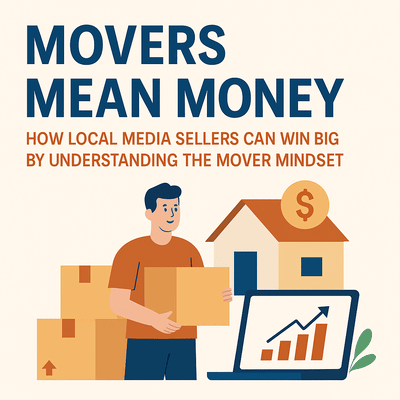
Movers Mean Money: How Local Media Sellers Can Win Big by Understanding the Mover Mindset
Realtor.com’s “Unpacking the Mover Mindset” reveals that movers are a high-value audience, making major purchase decisions within 90 days of relocating and showing increased openness to new brands and services. Local media outlets are uniquely positioned to connect advertisers with movers through trusted, community-based messaging. The Media Audit profiles newcomers and their media exposure. The Realtor.com report identifies three key phases of the mover journey—pre-move, move week, and post-move—and four mover personas, each with distinct needs and behaviors. Media sellers can capitalize on this by offering targeted ad packages, welcome guides, and geo-targeted campaigns aligned with mover timing and mindset. By leveraging these insights, local media can drive meaningful results for advertisers and deepen their role as essential partners in the community.

Why Big Tech Is Betting on Traditional Media - and What Local Outlets Can Learn
Big Tech companies like Apple, Amazon, Google, and Meta are increasingly investing in traditional media—such as newspapers, radio, and TV—to build trust, reach broader audiences, and manage their reputations. Apple uses full-page print ads to promote privacy, Amazon advertises on local radio to support hiring, and Google sponsors public radio to enhance brand credibility. Despite their dominance in digital advertising, these companies recognize the unique value of traditional media’s trust, attention, and community connection. Local media outlets can leverage this trend by emphasizing their credibility, loyal audiences, and hyper-local reach. If Big Tech sees value in traditional media, local advertisers should too.
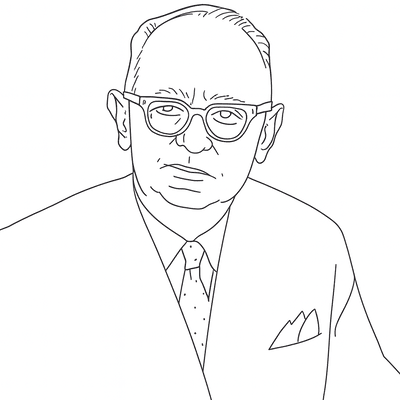
Leo Burnett: The Man Who Put a Pencil in His Mouth and Changed Advertising Forever
Leo Burnett, born in 1891 in Michigan, rose from humble beginnings to become one of the most influential figures in advertising history. He founded Leo Burnett Company in 1935 during the Great Depression and built it into a global powerhouse by championing emotionally resonant, character-driven campaigns like the Marlboro Man, Tony the Tiger, and the Pillsbury Doughboy. Known for his belief in the “inherent drama” of products, Burnett emphasized simplicity, sincerity, and storytelling in advertising. Despite early skepticism and economic adversity, he built a legacy rooted in trust, creativity, and consumer connection. His philosophy—“Make it simple. Make it memorable. Make it inviting to look at. Make it fun to read.”—continues to shape the industry today.
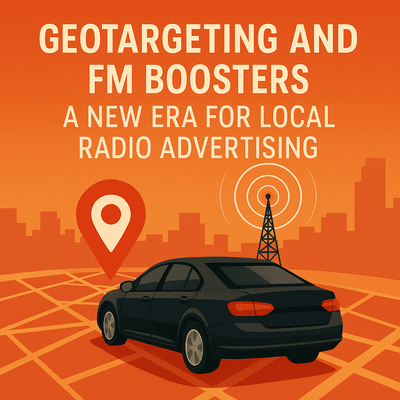
Geotargeting and FM Boosters: A New Era for Local Radio Advertising
Geotargeting has become a dominant strategy in advertising, with 87% of marketers now using it—creating a major opportunity for radio to compete with digital platforms. Thanks to new FCC rules, stations can now use FM boosters and technologies like ZoneCasting to deliver localized ads to specific neighborhoods. Advertiser interest in radio geotargeting has more than doubled since 2020, with 39% saying it makes them more likely to increase radio spending. Tools like Xperi’s DTS AutoStage now provide in-car listening data, helping stations show advertisers exactly where their audiences are tuning in. Together, these innovations position local radio to offer precision, relevance, and measurable ROI—making it a powerful tool for location-based marketing.
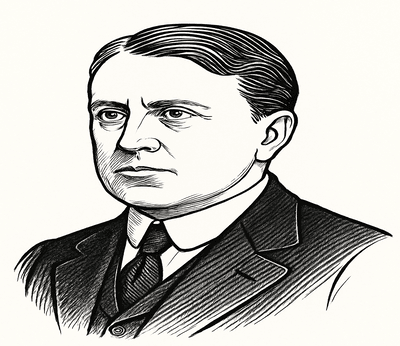
William Randolph Hearst: The Architect of American Media Influence
William Randolph Hearst revolutionized American media by transforming newspapers into powerful tools of influence, starting with the San Francisco Examiner and expanding into a national empire. His bold, sensationalist style—often controversial—captivated readers and reshaped journalism, while his leadership blended visionary ambition with hands-on editorial control. Hearst overcame fierce competition, financial crises, and public scrutiny by diversifying into magazines, radio, and film, demonstrating adaptability and strategic foresight. His marketing genius lay in emotional storytelling, audience-first content, and cross-platform branding—lessons that remain vital for today’s media sales professionals. Hearst’s legacy is a testament to the power of bold ideas, relentless innovation, and the enduring impact of compelling narratives.
AI Tools for Media Sales & Local Marketing
AI tools are helping media sales and local marketing teams improve their work. They support sales management, content creation, ad optimization, and customer engagement. These tools speed up tasks and help teams connect better with local audiences.

Mark Zuckerberg: From Dorm Room Visionary to Global Tech Leader — Lessons for Local Media Sales Reps
Mark Zuckerberg’s journey from a Harvard dorm room to leading Meta showcases his visionary leadership, product-first mindset, and resilience under pressure. He built Facebook by prioritizing user experience, embracing bold risks like acquiring Instagram and pivoting to the metaverse. His management style emphasizes mission-driven culture, strategic delegation, and long-term thinking. Case studies such as the Cambridge Analytica response and Meta’s global expansion highlight his ability to lead through crisis and scale effectively. Local media sales reps can learn from his approach by innovating, embracing technology, building trust, and thinking beyond short-term wins.
Hiring the Next Generation of Local Media Sellers: What to Look For
As local media evolves, hiring sales talent requires a shift from traditional experience to digital fluency, data literacy, and strategic thinking. The next generation of sellers must be curious, coachable, and capable of using AI and analytics to craft personalized, results-driven campaigns. Strong storytelling skills and a passion for local communities remain essential for building advertiser trust. Managers should prioritize mindset and adaptability over legacy media experience and use role-based assessments to evaluate real-world skills. By hiring for future-ready capabilities, local media companies can build sales teams that thrive in a hybrid, tech-enabled marketplace.

Comprehensive Hiring Checklist: Next-Gen Local Media Sellers
Hiring the next generation of local media sellers requires a shift from legacy experience to candidates who are digitally curious, data-literate, and self-motivated to win. Top performers are organized, goal-driven, and possess a natural competitive spirit that fuels consistent follow-through and client success. Strong hires also demonstrate consultative selling skills, storytelling ability, and a passion for helping local businesses thrive. Managers should watch for red flags like tech aversion, disorganization, and a transactional mindset, which often signal underperformance. By focusing on mindset, adaptability, and strategic thinking, local media companies can build sales teams equipped to lead in a hybrid, AI-enhanced marketplace.

Know Who You're Talking To: The Power of Personality-Based Selling (and Living)
Understanding and adapting to a buyer’s personality type is a critical sales skill that can significantly improve close rates, reduce objections, and build long-term relationships. Drawing from DISC and MBTI frameworks, buyers can be categorized into four core types—Driver, Analytical, Amiable, and Expressive—each with distinct motivations and communication preferences. The article provides detailed strategies for identifying and selling to each type, including hybrid personalities, using real-world examples and role-play scenarios. It also highlights the risks of misalignment, such as being ghosted or losing credibility, and offers advanced techniques for adapting in real time. Beyond sales, this approach enhances communication in all interpersonal relationships, from family to the workplace.

Joe Girard: The Spark That Sold the World
From the Streets of Detroit to the Guinness Book of World Records
Joe Girard, born to Sicilian immigrants in Detroit's impoverished east side, overcame an abusive childhood to become the world's greatest salesman, selling more retail cars than anyone in history for 12 consecutive years. Influenced by Dale Carnegie, Vince Lombardi, and Napoleon Hill, Girard built his success on relentless personalization, fanatical follow-up that generated 65% of sales from referrals, an unmatched work ethic, and deep empathy that focused on solving customer needs rather than pushing products. His methods—including the 250 Rule and systematic relationship building—translate perfectly to modern media sales, where success still depends on human connection over digital metrics. His legacy proves that in an age of automation, the fundamentals of genuine care, consistent follow-up, and serving others remain the true differentiators for extraordinary sales results.

Mastery and Self-Made Brian Tracy: The Complete Blueprint for Sales Success
From Charity Clothes to Global Influence: The Foundation Years
Brian Tracy transformed himself from a poverty-stricken high school dropout in Prince Edward Island into one of the world's leading success and sales authorities through systematic self-education and disciplined study of masters like Napoleon Hill and Dale Carnegie. He developed practical systems like the ABCDE priority method, the 10-goal system, and consultative selling techniques by treating real-world sales interactions as scientific experiments to refine his approach. His influence has reached millions across 58 countries through books, seminars, and audio programs that prove success comes from systematic daily habits and continuous learning rather than natural talent. Tracy's enduring legacy demonstrates that ordinary people can achieve extraordinary results by consistently applying his learnable systems for time management, goal-setting, and sales psychology.

Napoleon Hill: The Architect of Modern Success Philosophy
From Poverty to Global Influence - The Man Who Transformed How the World Thinks About Success
Napoleon Hill, born into poverty in rural Virginia, rose to global prominence by pioneering the modern philosophy of success through his groundbreaking work,
Think and Grow Rich. His life changed after a pivotal meeting with Andrew Carnegie, who challenged him to study and distill the habits of 500 of the most successful people of the era. Hill’s research led to the creation of 17 principles of achievement, including Definiteness of Purpose, the Mastermind Principle, and Applied Faith—concepts that remain foundational in personal and professional development. His teachings are especially relevant to media sales and ad agency professionals, offering strategies for goal setting, resilience, collaboration, and client success. Hill’s legacy endures as a blueprint for turning adversity into advantage and ambition into achievement.
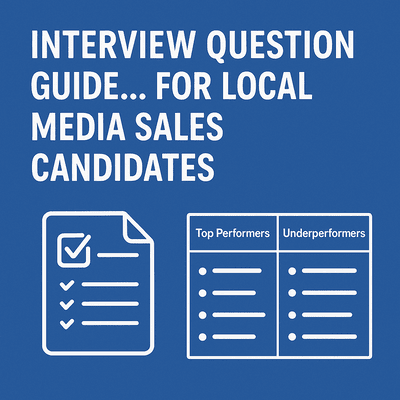
Interview Question Guide… for Local Media Sales Candidates
This interview guide helps local media managers assess next-gen sales candidates across key traits like digital fluency, data literacy, storytelling, and competitive drive. It organizes questions into categories such as planning, motivation, tech comfort, and local market passion, with a 5-point scoring system for consistent evaluation. A new section highlights red flags like disorganization, tech aversion, and a transactional mindset. It also includes a comparison chart outlining the strengths of top performers versus the weaknesses of underperformers. Together, these tools help hiring teams identify candidates who are not only skilled but also adaptable, strategic, and aligned with the future of local media sales.